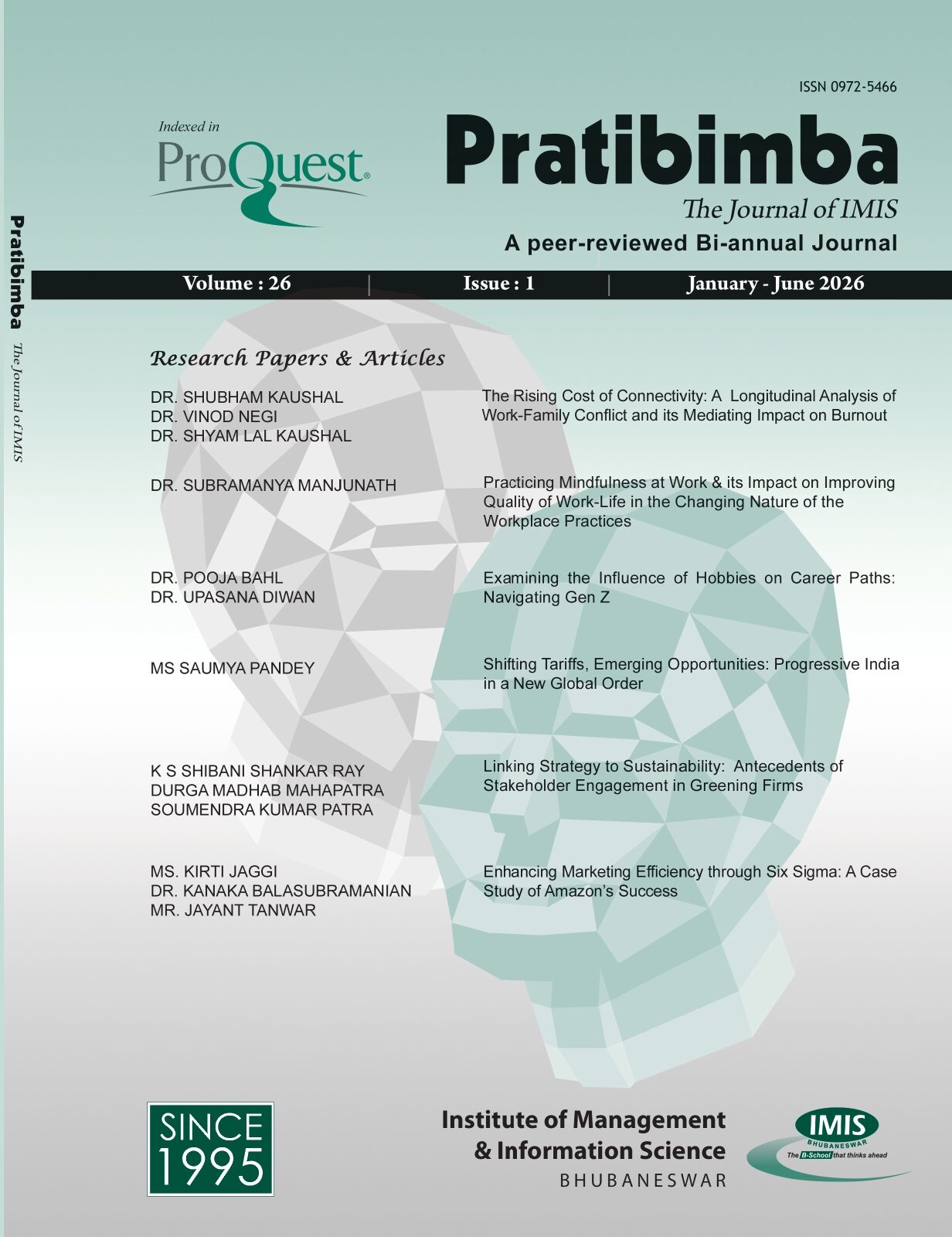
The Rising Cost of Connectivity: A Longitudinal Analysis of WorkFamily Conflict and its Mediating Impact on Burnout
TITLE
The Rising Cost of Connectivity: A Longitudinal Analysis of Work-Family Conflict and its Mediating Impact on Burnout
AUTHOR
Dr. Shubham Kaushal1
, Dr. Vinod Negi2
, Dr. Shyam Lal Kaushal3
ABSTRACT
The rapid expansion of digital technologies and the normalization of hybrid and remote work culture have blurred the traditional boundaries between the work and personal life. With this context the present study was conducted to investigate the long-term impact of After-Work Hours (AWH) digital connectivity on employee burnout, with Work-Family Conflict (WFC) as a mediating mechanism. Adopting a longitudinal comparative design for WFC and cross-sectional study design for AWH and Burnout, 210 employees were surveyed using standardized instruments, which included the Work-Family Conflict Scale, Perceived Right to Disconnect Scale, and Oldenburg Burnout Inventory. The study findings revealed a significant increase in WFC over the time from 2021 to 2025, indicating an erosion of work-life boundaries. Aftezr-work hours connectivity was found to significantly predict both WFC and burnout, with WFC partially mediating this relationship, accounting for approximately 44% of the total effect. Also, significant gender differences were noted with the female employees reporting higher levels of AWH connectivity, WFC and burnout. The study thus provides validation of how temporal extension of work into personal space serves as a critical pathway to psychological strain, highlighting the need for organizational polices to be supportive in terms of boundary management and employee well-being.
Keywords: Work-Family Conflict, After-Work Hours Connectivity, Burnout, Mediation, Pandemic.
1 Dr. Shubham Kaushal, Faculty, Himachal Pradesh Technical University, Hamirpur, Himachal Pradesh, 177001
2 Dr. Vinod Negi, Associate Professor, Himachal Pradesh University Business School
3 Dr. Shyam Lal Kaushal, Professor, Himachal Pradesh University Business School
For full text kindly
Practicing Mindfulness at Work & its Impact on Improving Quality of Work-Life in the Changing Nature of the Workplace Practices
TITLE
Practicing Mindfulness at Work & its Impact on Improving Quality of Work-Life in the Changing Nature of the Workplace Practices
AUTHORS
Dr. Subramanya Manjunath1
ABSTRACT
The world of business has undergone dramatic changes, particularly from the later part of the second decade of the present century. Digitalization has transformed not only the business processes but also the way people live and work. In other words, digitalization has engrossed the entire market economy. Further, the advent of digitalization has compelled business enterprises to manage the needs and demands of customers in a fast-paced working environment that needs to be fueled with consistency in innovation and agility. Further, it is relevant to note that in sectoral industries, employees, irrespective of their workplace, started perceiving and experiencing a higher workload to meet the needs of customers and seem to be more stressed than ever before and even burned out on various occasions at work and find it difficult to maintain their work-life balance. In such a situation, resilience is critical for both the employer and the employees in an organization, which is essential to continuously strive to improve productivity and sustain business in view of the ever-increasing global trends and competition. To manage such a situation, some of the organizations have realized and learned that to overcome unprecedented and unanticipated challenges, resilience of employees as well as the organization is the key to sustaining business. From this perspective, this research aims to understand and gain insight into mindfulness at work, which in turn aids the employees to develop resilience and facilitates them in improving their quality of work-life. The study also examines and comprehends the relevance of mindfulness at work in improving organizational productivity and its impact on developing employee resilience and work engagement.
Keywords: Digitalization, Resilience, Mindfulness, Work-life Balance, Quality of Work life, Competition, Globalization, Business Sustainability
1Former Principal and Dean, SSIMS, Tumkur, Karnataka; Visiting Faculty: Christ University and Jain University, Bangalore. Advisor – HRM to Industries and Corporate Trainer, Email: drmsblr@gmail.com
For full text kindly
Examining the Influence of Hobbies on Career Paths: Navigating Gen Z
TITLE
Examining the Influence of Hobbies on Career Paths: Navigating Gen Z
AUTHOR
Dr. Pooja Bahl1
, Dr. Upasana Diwan2
ABSTRACT
This research explores the relationship between hobbies and career development among Generation Z (Gen Z), a demographic known for digital fluency, entrepreneurial tendencies, and value-driven career preferences. Despite having unprecedented access to online resources and creative platforms, many Gen Z individuals struggle to translate their hobbies into viable professional paths. The study seeks to explore the role of hobbies in influencing career interests, building transferable skills, and improving personal well-being, as well as exploring the obstacles hindering Gen Z from utilizing these interests in their careers. Adopting a descriptive research design, the research collects data to explore how personal interests influence career choices. The results uncover a disconnect between Gen Z’s passive online interaction and active skill development needed to create a career out of a hobby. Excessive social media use, the absence of structured mentorship, and a desire for instant rewards are highlighted as major inhibitors. This article highlights the importance of cultivating meaningful hobby participation and offers suggestions for how teachers, employers, and counselors can help Gen Z bridge the gap between passion and career.
Keywords: Gen Z, Hobbies. Career path, Passion
1 Professor, Rukmini Devi Institute of Advanced Studies, New Delhi, India
2 Associate Professor, Rukmini Devi Institute of Advanced Studies, New Delhi, India
For full text kindly
Shifting Tariffs, Emerging Opportunities: Progressive India in a New Global Order
TITLE
Shifting Tariffs, Emerging Opportunities: Progressive India in a New Global Order
AUTHORS
Ms Saumya Pandey1
ABSTRACT
It is said that when two giants’ squabble, the world hears the sound; the world economy saw a massive twist in the form of tariff tension between the US and India. Two giants, one from the west and the other from the east, had their face-off over trade deals. The world saw two strategically allied nations stand against each other, not to rush to war but to wage a trade war. Initially, in July 2025, the US imposed a 25% tariff, increasing it to 50% in August, and later imposed a number of sanctions on India. The US accused India of buying Russian oil to support its economy in a pompous, inhumane war against Ukraine. Still, the truth lies under several layers of hypocrisy as European nations, Turkey, China & even the United Nations bought crude oil worth billions of US dollars from Russia and were not bombarded with the same Tariff rates. Is the smoke coming out because of India’s trade ties with Russia, Japan, China & European Union is now troubling the US tremendously? But India mending its way strategically, 27th Jan 2026 added a golden feather in our cap, PM Shri Narendra Modi has cracked the “Mother of all deals” the much awaited and important trade decision pending since last twenty years on Free trade deal has been finalized with European Union (E.U) for the sustainable trade practice, it would open a new wide bandwidth of export opportunities for Indian goods. Export duties would be reduced up to 10% or even Zero once the agreement comes into effect. This deal will boost our presence in the global manufacturing of textiles, apparel, leather and automobiles. The aftereffect of this “free trade deal” is that the US is negotiating tariffs on India from 50% to18% under the revised tariff rates.
Keywords: Imposed tariffs, trade deals, global manufacturing, export duties, sustainable trade practice.
1Assistant Professor, Faculty of Management, Krishna School of Business Management, Drs. Kiran and Pallavi Patel Global University, Vadodara, Gujarat.
For full text kindly
Linking Strategy to Sustainability: Antecedents of Stakeholder Engagement in Greening Firms
TITLE
Linking Strategy to Sustainability: Antecedents of Stakeholder Engagement in Greening Firms
AUTHOR
K S Shibani Shankar Ray1
, Durga Madhab Mahapatra2
, Soumendra Kumar Patra3
ABSTRACT
While substantial knowledge is available on stakeholder engagement, there has been limited exploration on it for sustainability purposes and the determinants that might influence it. The paper investigates factors influencing a firm’s ability to engage stakeholders in mitigating value chain emissions. The research paper proposes that internal (i.e., board oversight of climate-related issues and incentivization) and external (i.e., climate change commercial risk opportunity and ESG controversies) factors, along with contingencies (e.g., emission targets and management commitment) might drive firms to engage with stakeholders for value chain emissions. The essay relies on the tenets of control theory to theorize the effects. Using data from 226 firms and a robust empirical setup, the research finds that board oversight, incentivization, and climate change commercial risk opportunity positively influence firm’s engagement with stakeholders for value chain emissions, but there is no significant influence of ESG controversies.
Keywords: Stakeholder engagement, emissions, climate change risk opportunity, antecedents
1 Giet University, Gunupur, India
2 North- Eastern Hill University, India
3 Ravenshaw University, India
For full text kindly
Enhancing Marketing Efficiency through Six Sigma: A Case Study of Amazon’s Success
TITLE
Enhancing Marketing Efficiency through Six Sigma: A Case Study of Amazon’s Success
AUTHOR
Ms. Kirti Jaggi1
Dr. Kanaka Balasubramanian2
Mr. Jayant Tanwar3
ABSTRACT
This paper examines the integration of Six Sigma methodologies into Amazon’s marketing strategies from 2020 to 2025. Six Sigma, a data-driven approach to reducing defects and variability, has significantly enhanced Amazon’s operational efficiency and customer satisfaction. By embedding DMAIC (Define, Measure, Analyze, Improve, Control) into its marketing processes, Amazon improved campaign effectiveness and customer retention. Secondary data from Amazon reports and academic sources were analyzed using tools such as Control Charts, Pareto Analysis, and Fishbone Diagrams. Hypothesis testing confirmed a statistically significant positive impact of Six Sigma on marketing performance. The study concludes with strategic recommendations for wider Six Sigma adoption across Amazon’s platforms. Limitations include reliance on secondary data and external factors. Future research should explore integrating Six Sigma with AI in digital marketing.
Keywords: Amazon, Customer Satisfaction, DMAIC, Operational Efficiency, Six Sigma
1Assistant Professor, Asian Law College, E-mail: kirti.jaggi@alc.edu.in
2Professor, Gitarattan International Business School , Affiliated to GGSIU, Delhi,Email:kanaka.balasubramanian@gitarattan.edu.in
3MBAIB Scholar, Gitarattan International Business School, Affiliated to GGSIU, Delhi, E-mail: jayanttanwar34@gmail.com
For full text kindly